
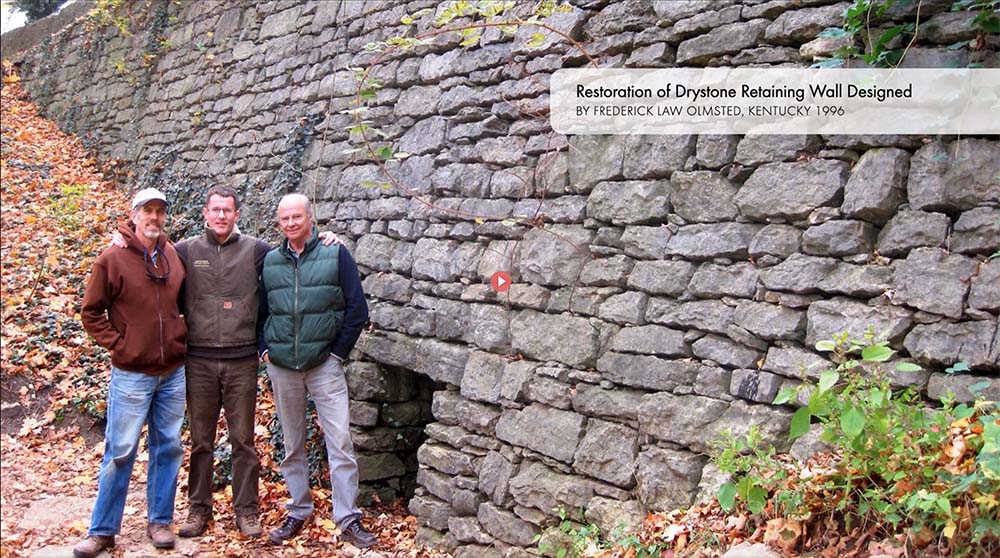
This is a video about best practices in stonemasonry, which I created for the Pecha Kucha program. It contrasts the traits of well-built stonemasonry that lasts for centuries with the traits of poorly-built stonemasonry requiring frequent repair. The municipal-scale stone retaining walls I worked on in Kentucky 30 years ago used best known practices. The stone retaining walls in the Santa Fe River in New Mexico don’t use best known practices. In 2020, some of the stone retaining walls in the Santa Fe River were rebuilt for the 2nd time in 10 years. They failed twice before due to their construction methodology. Then, they were rebuilt twice using the same flawed methodology. Because the retaining walls were adjacent to my home, I was very familiar with them. Recognizing that they were exemplary of large, municipal scale stonework shortcomings, I learned everything I could about their history.
DSWA and Best Practices in Dry Stonemasonry:
In the mid 1990’s, the Dry Stone Walling Association drystone mason and educator Richard Tufnell came to Kentucky from Scotland to lead repairs of municipal scale stone projects. Tufnell also led training workshops in Kentucky on best practices in drystone masonry. Tufnell had decades of experience with stone projects in over 40 countries, including World Heritage Sites. Thus, he had a global perspective on the traits of well-built stonemasonry. Many of the traits he showed us were quantified in different publications of the DSWA. That organization and others also train and test people on best practices in dry stonemasonry.
Archeoastronomy:
I worked for 7 years on municipal, commercial, agricultural, and residential dry stone projects in Kentucky using best practices. Those are the same methods I have used in my stonemasonry installations since 2003. During that era, I developed an interest in stonemasonry that marks astronomy. This was the result of watching the 1999 documentary film about Native American stonemasonry and petroglyphs, The Mystery of Chaco Canyon. I recognized there were a range of educational opportunities in global stonework that marks astronomy. That was not part of my training in drystone, yet it was evident in global drystone (and mortared) stonemasonry.
Advocacy of Best Practices in Stonemasonry:
In conclusion, the stone retaining walls in the Santa Fe River missed two opportunities. The first was that the walls could have demonstrated best practices in stonemasonry, but didn’t. The second was that the walls could have marked astronomy, but didn’t. One of my goals professionally within the craft of dry stonemasonry is to advocate for best practices, and inclusion of astronomical educational traits. This will most likely happen through professional development training with organizations and individuals involved with stonemasonry.
